國家 / 語言
更改國家/地區
選擇其他國家或地區,查看關於您所在地區的內容。
選擇您的語言
couple buying washing machines

Industry trends consumer durables May 2026

Households rein in spending in response to Gulf conflict price rises
19 May 2026

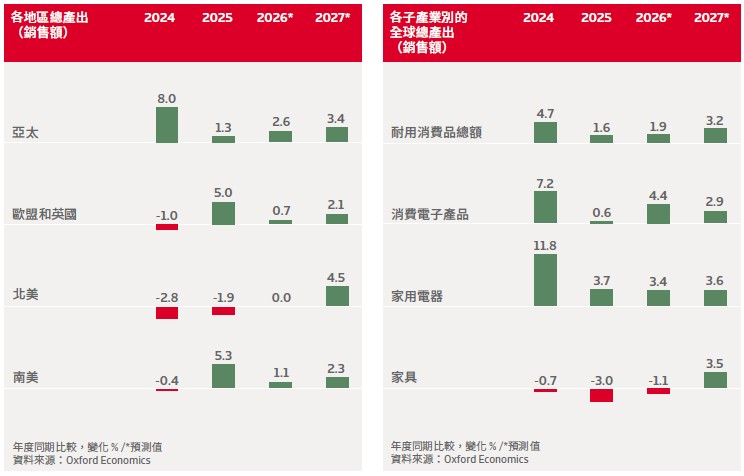
Global overview: Sector affected by lower discretionary spending as energy prices surge

The closure of the Strait of Hormuz has pushed up oil prices in most parts of the world. Along with price increases for gas, fertiliser, and agricultural commodities, this will push world consumer price index inflation up to a peak of 4.4% in Q2 of 2026, an unwelcome development for households.

Higher energy and food prices squeeze disposable incomes and will lead to less discretionary spending. There will be a negative impact on sales of domestic appliances and furniture items, but also on consumer electronics. 

At the same time consumer durables producers face higher input costs for energy and certain commodities. 

Under a prolonged Gulf conflict scenario global inflation would rise to 7.7% in 2026. In such a case, global consumer durables sales growth would lower to 0.4%, 1.5 percentage points lower than currently expected. 

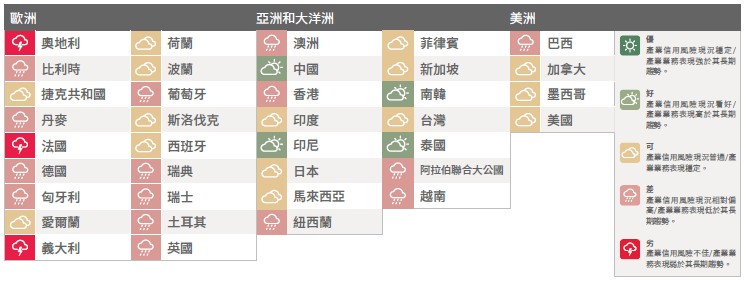
The credit risk of consumer durables retailers in many advanced markets remains elevated, with smaller players especially vulnerable to defaults and insolvency. The sector operates in a fiercely competitive environment with thin margins.

United States: Lower private consumption weighs on sector performance

US private consumption growth is expected to slow down to 1.7% this year after growing 2.6% in 2025. The pass-through of energy cost increases to core prices will play out over the coming months, and US consumer prices will increase by 3.3% in 2026. Both higher gasoline and consumer price inflation will erode real incomes, weighing on household spending. 

The production of US consumer goods is expected to remain subdued in the near term, and we forecast sales of consumer durables to contract by 0.4% in 2026. Discretionary spending and demand for durable goods are the most exposed to the current developments, as big-ticket purchases are typically deferred when energy prices, inflation and uncertainty rise. 

Sales prices have increased well above trend for household appliances, electronics and furniture items. Most importers were not able to push for cheaper prices from suppliers, nor were they able to absorb the full cost of tariffs on their margins. Retailers absorbed parts of the additional costs at the expense of their profits but mostly passed them on to consumers.

A few US producers have gained higher pricing power, but at the same time tariffs have increased input costs for domestic manufacturers (e.g. for metals). In general, the options to reshore the production of consumer durables are limited, as US manufacturers lack the infrastructure and specialised skills to ramp up large-scale output in the short term, while labour costs are also an issue.

In 2027 we expect a robust rebound of consumer durables by 5%, in line with stronger economic and household consumption growth and a retail sales increase of 2.5%.

China: Lower growth as consumer sentiment remains volatile

The retail market in China is currently the second-largest consumer market globally, with total retail sales of consumer goods reaching CNY 50.12 trillion (approximately EUR 6.23 trillion) in 2025. Online retail sales of physical goods continue to outpace offline growth.

We expect consumer durables sales to grow by only 2.5% in 2026, despite a boost in early 2026 due to Chinese New Year demand. In 2027 we expect the consumer durables sector to grow by 3.2%.

While China is relatively insulated from the global energy shock generated by the war in the Gulf compared with many other regional peers, signs of second-round spillovers are beginning to show. Chinese consumer sentiment remains volatile, mainly due to the ongoing issues in the property sector.

A deflationary environment, weak wage growth and higher unemployment are additionally impeding higher consumer spending, in particular for big ticket items. 

Chinese furniture manufacturing is set to contract by 3.7% in 2026 after a 6.4% decrease in 2025. Property market issues and US tariffs continue to weigh on exports of home goods. 

Japan: Low consumer confidence weighs on the sector

After major declines in 2024 and 2025 we expect sales of consumer durables in Japan to rebound by only 1.9% year-on-year in 2026 and to level off in 2027. High energy costs will constrain private consumption, in particular of durable goods. 

In the long run, the ageing and declining population size will mean weaker consumption prospects.

France: Household spending hit by higher inflation

After two years of subdued performance we expect French sales of consumer durables to contract again in 2026, by 1.8%. Domestic consumption is impacted by the war in the Gulf war´s impact on inflation and ongoing political uncertainty. 

Credit risk in the retail segment remains elevated. Inventories are quite high due to low levels of demand, and financial partners are increasingly restrictive with short-term facilities. Margins are generally low across all subsectors. 

The level of payment delays and insolvencies remains high among smaller retailers. Large, specialised retailer groups are financially healthier, as they keep on gaining market share. 

Germany: A contraction amid increased payment delays and insolvencies

In 2026 we expect retail sales growth in Germany to slow down to 0.1%, and consumer durables sales to contract by 2.1%. Consumer sentiment has deteriorated due to the Gulf conflict, as fuel prices have sharply increased, eroding purchasing power. 

The return of higher inflation, elevated uncertainty, and labour market softness will weigh on spending decisions, in particular for discretionary items. Any renewed pressure on household finances risks a further dampening in spending.

All this hits a sector that has already struggled with higher credit risk over the past couple of years. In particular, the retail segment is suffering with high input costs, expensive credit and thin margins. 

The level of payment delays and insolvencies has been elevated in 2025 and early 2026, and we expect further increases in the coming months due to the adverse market outlook.

United Kingdom: Market conditions are deteriorating

We expect UK private consumption growth to slow down to 0.4% this year, and consumer durables sales to contract by 1.1%. 

We forecast real household incomes to fall by 0.2% this year, which would be the weakest performance since 2022. Consumers are adopting a more cautious, wait-and-see approach and deferring major purchases as uncertainty persists.

Credit risk in the retail segment remains elevated, and maintaining strong liquidity discipline through stock and supply chain management will be critical for success. Smaller players are struggling most in the shrinking market, as many are unable to access more favourable pricing and payment terms.
 

Summary

Global: Higher energy and food prices squeeze disposable incomes and will lead to less discretionary spending

USA: Production of consumer goods is expected to remain subdued, and we forecast sales of consumer durables to contract by 0.4% in 2026

China: Issues in the property sector, a deflationary environment, and weak wage growth affect consumer spending for big ticket items

France: After two years of subdued performance, we expect sales of consumer durables to contract again in 2026, by 1.8%

Germany: higher inflation, elevated uncertainty, and labour market softness will weigh on spending decisions, in particular for discretionary items

UK: Smaller retailers are struggling most in the shrinking market, as many are unable to access more favourable pricing and payment terms
 

相關文件
Industry trends consumer durables May 2026
3 MB PDF